How to choose a payments provider for your AI agent: 4 questions to ask
4 questions to ask before you build on an agent wallet
If you’re building an agent that buys things for your users, at some point you choose how it pays. Many of the options describe themselves the same way: a vault for cards, works globally, your branding. The differences show up after launch, when a user abroad saves a card or your agent reaches a store it can’t buy from.
These are the four questions we’d ask any agent wallet before building on it, and how we answer them at Agentcard.
- Do your users’ cards work, from any country?
- Whose brand does your user see, yours or the wallet’s?
- Does your user have to top it up before the agent can buy?
- Can you see where it works before your agent tries?
Do your users’ cards work, from any country?
Your users already have cards, and they aren’t all US Visa credit cards. Every card the wallet can’t take is a user your agent can’t buy for.
What to ask: which card types, which networks, which countries, and which currency the store charges in.
Our answer: Agentcard Vault takes any card: credit, debit, prepaid, commercial or consumer; Visa, Mastercard or Amex; from any country. Cards transact in the store’s currency.
Whose brand does your user see, yours or the wallet’s?
Saving a card is the moment your user decides whether to trust you. If the form carries another company’s name, or sends them to another site, they’re handing their card to a company they never signed up with.
What to ask: can you set the logo, colors and fonts? Can the form run on your domain? Does approval happen inside your app, or does it redirect?
Our answer: Yours. Logo, colors and typography are set in the dashboard, and the form can run on your domain. Approval runs in an iframe or web view inside your app, with no redirect. When the agent is ready to pay, you get an approval link to send your user in your app or your chat.
Does your user have to top it up before the agent can buy?
A balance adds a step before the first purchase: your user moves money in, and only then can the agent spend. When the balance runs low, the agent stops until they top it up again.
What to ask: does the agent pay with the card your user already has, or from a balance they fund? What happens to their points and their disputes?
Our answer: No top-up. Your user saves their own card once, and the agent pays with it. It’s their real card on the card network, so their rewards accrue, the statement shows the actual store, and disputes go straight to their bank.
The card is encrypted with a passkey on their phone, and neither the agent, you nor Agentcard ever sees the raw number. Each purchase waits for your user to approve it with Face ID, unless they turn on auto-approval under an amount they choose, like $50. How the Vault works, step by step.
Can you see where it works before your agent tries?
A card that works gets you halfway. The agent still has to get through the store: find the product, build the cart, check out. That’s where purchases fail, and a wallet alone doesn’t fix it.
What to ask: which stores have you tested, can I see the results, and what does my agent get back when a purchase fails?
Our answer: opencommerce gives your agent one endpoint for 5,026 online stores: catalogue search, cart, checkout and order tracking. We test thousands of those stores and publish every result on our monitoring page, with each store’s success rate, last run, first response time and 45 days of history. On the day we published this, Amazon, Walmart, Target, DoorDash, Best Buy and The Home Depot were all at 100%.
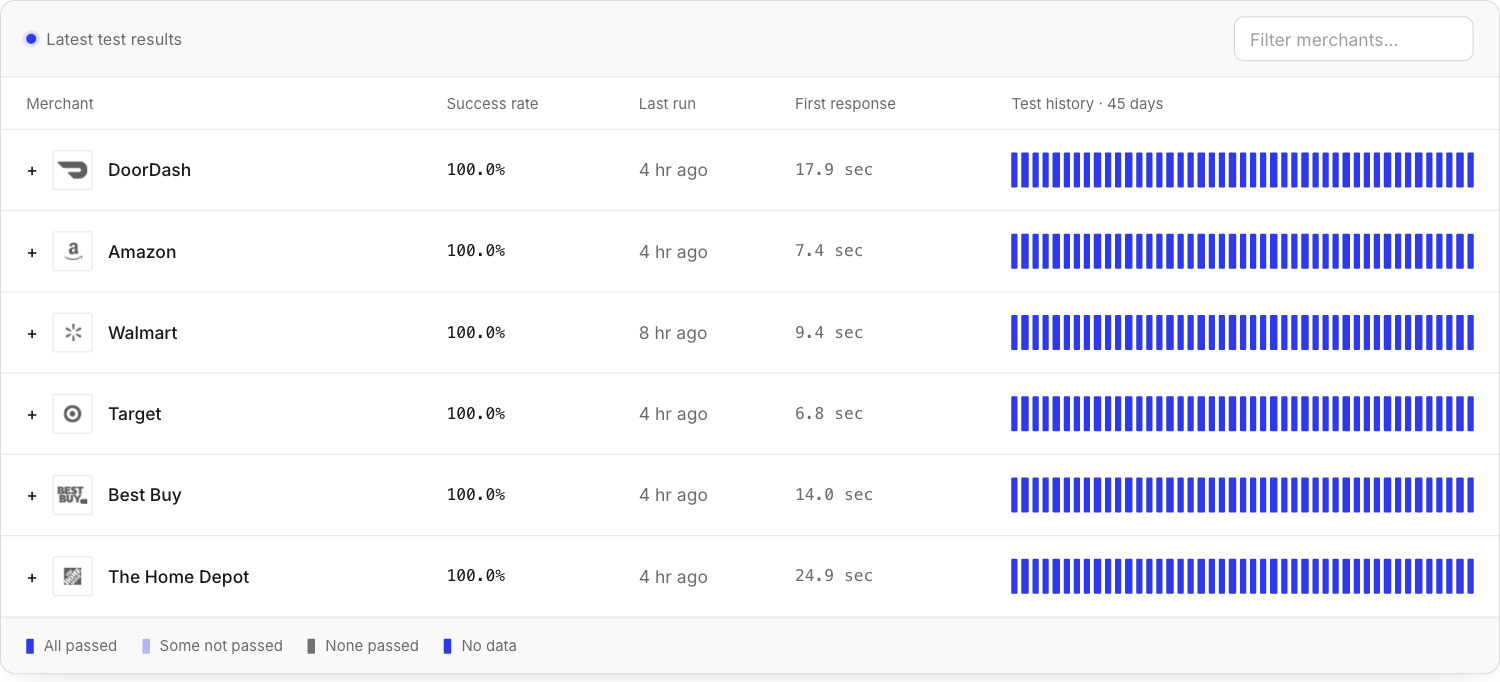
Your code can check too. The merchants endpoint tells you, for any store you name, whether Agentcard can pay there and why. When a purchase fails, your agent gets an order.failed event with the reason, like an item that’s unavailable, so it can offer your user another store.
If your agent runs its own browser, the Vault works on any checkout that takes cards: 23 payment processors mapped, plus native integrations for Amazon, DoorDash, eBay, Best Buy and airlines. It plugs into Browser Use, Kernel, Browserbase, Anchor or your own browser, and the final request goes out from your user’s device, which cuts bot-detection failures compared with server VMs.
Ask these four of any wallet you’re considering, us included, and ask to see each answer working.
Building an agent that buys for your users? See how the Vault works or book a call.